

Introduction
Spiral dynamics is a model developed by Clair Graves and further built upon by Don Beck and Christopher C. Cowan.
The model describes how systems (worldviews/values) evolve, both individually and collectively.
What is a system?
A system is a complex set of parts that interact with each other to achieve some goal.
Systems tend to seek self-preservation. A human is a system of body parts working together for self-preservation. Worldviews, ergo belief systems, are systems made out of beliefs, also with the goal of self-preservation. Families, companies, and societies are all systems of people interacting together, ultimately to continue functioning.
Parts within systems often interact with each other in unexpected ways. Changing a part can change the whole system in an unexpected way. Medicine is an excellent example; taking medicine for an issue might just cause another even worse one. Introducing a new law, such as criminalizing drugs to reduce drug use, could backfire and cause the totally opposite result.
This counter-intuitiveness is why understanding systems is so important. Changing one thing could easily backfire.
| Examples of systems |
|---|
| The human body Organs themselves The mind Worldviews Routines / daily schedules Electronic devices (computers etc.) Families Friend groups Workplaces Companies Communities/organizations The economy Public healthcare Public transportation Politics Society Ecosystems Food chains The world itself The solar system |

Why Spiral Dynamics matters
The model helps you understand why a system (a person, company or country) behaves the way they do. It helps you understand the needs and wants of different systems. It helps you predict how a system will react to changes.
To summarize, it helps you understand the world better, which is important if you want to make the right decisions.
Summary of Spiral Dynamics
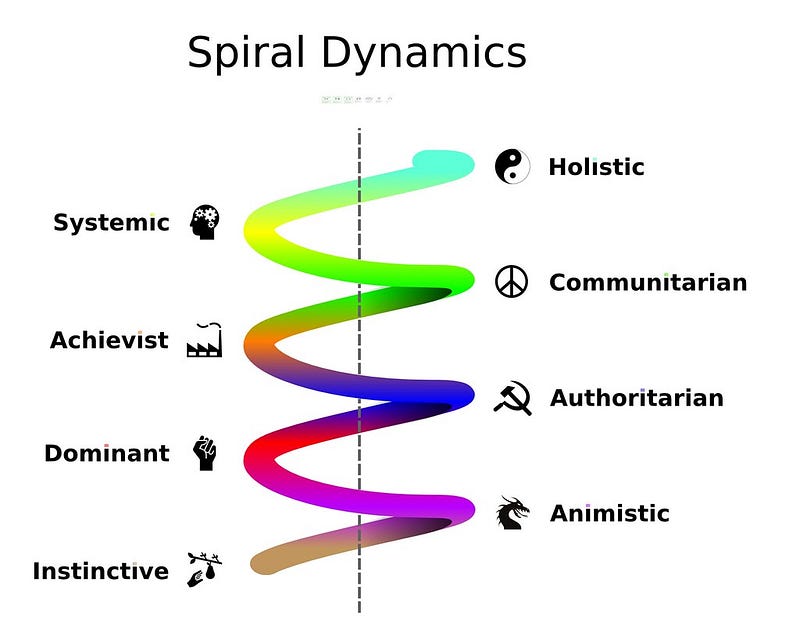
There are 8 different stages that systems evolve through, and these stages have been given different colors.
The model can also be seen as a model of identity development because what you consider as “us”, gets larger and larger the higher you are on the spiral.
The Stages:
- Beige: survival stage
- Purple: tribal magic stage
- Red: egocentric self-indulgence stage
- Blue: order and meaning stage
- Orange: science & success stage
- Green: social cause, emotional, and spiritual stage
- Yellow: systemic stage
- Turquoise: holistic & global stage
Important caveats
A system, such as a person can be on multiple stages at the same time, but there’s usually a dominating stage.
No stage is “better” or “worse”, they’re simply survival strategies for different environments.
The point of Spiral Dynamics isn’t to class people, it’s simply a tool you can use to understand systems, and every tool has its limits. In reality, the world and people are too complex to be fully explained by such systems.
Summary of the model (YouTube)
Stage Beige — The Survival Stage
Stage Beige is the first stage on the spiral, where the only focus in life is getting your physiological needs met (food, water, sex, shelter).

Your identity is very simple at Stage Beige, only YOU matter, and only your survival matters. You will do anything in order to survive, you will cry, steal, and murder, so you can get your physiological needs met.
Objective in life: Survival
| Characteristics |
|---|
| Instinctive Individualistic |
| Values |
|---|
| Physiological needs (food, water, sex, safety) |
| Examples |
|---|
| The first humans Babies Animals |

Why evolve?
You can’t survive that well on your own, you need to recognize the existence of other people.
Stage Purple — The Tribal Magic Stage
You care about more than just yourself at Stage Purple; you survive as a tribe. The tribe becomes like a single organism, where the individuals don’t have any autonomy. Everything is for the sake of the tribe.
At Stage Purple there’s more to life than survival, the tribe has culture, tribal clothing, celebrations, rituals, traditions, and rites of passage.
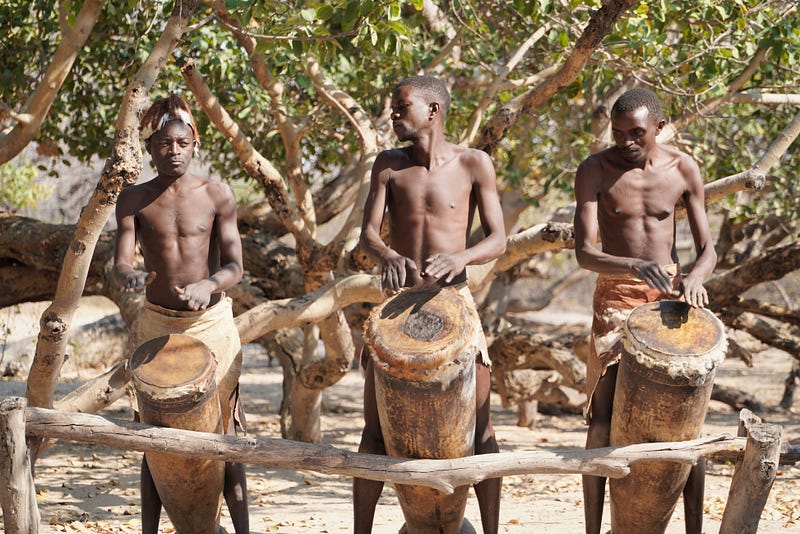
Objective in life: The tribe’s survival, to please the spirits
Seeks truth in: spirits, nature, and wise elders
| Characteristics |
|---|
| Collectivistic Spiritual Traditional Intuitional |
| Values |
|---|
| Community, connection Contribution to the tribe Mother nature Traditions, telling of myths, folk tales Respect for elders, ancestors, wisdom & experience |
| Examples |
|---|
| Amazon rainforest tribes Mythology Superstition Urban legends Animism Toddlers Kindergarten friend groups Ewoks from Star Wars |

Lessons learned
- We’re a communal species; the importance of social bonds and socialization
- The value of emotions, nature, and spirituality
- Importance of slowing down and living minimalistically
Why evolve?
Stage Purple doesn’t allow for individual ambition, everything is about the tribe. You have to question tradition and magical thinking.
Stage Red — The Egocentric Self-indulgence Stage
Stage Red is about satisfying yourself. Taking from others and dominating them by being on top, by being the strongest. Stage Red doesn’t care about other people’s suffering.
Stage Red is still seen a lot today, especially in areas with war and criminality.
Again, no stage is “evil” or “bad”, it’s a fully working survival strategy in a dangerous environment, and you never know when you need to utilize your inner Stage Red to protect yourself or your family.

Objective in life: To dominate others and get all resources for yourself
Seeks truth in: itself (what I think is what is true)
| Characteristics |
|---|
| Individualistic Impulsive Egocentric Manipulative Violent Entitled Lacks guilt Cocky |
| Values |
|---|
| Strength & power Displays of toughness Bragging Being nr. 1 Status Respect Revenge Materialistic & practical things (money, drugs, sex) |
| Examples |
|---|
| Vikings Spartans Pirates Genghis Khan Criminals Dictators Criminal gangs (Mexican drug cartels) Violence, intimidation, torture War itself Gladiator fights Strength contests, arm wrestling Lying (pathological liars) Narcissists & psychopaths Toxic masculinity Elementary-middle school age Sith from Star Wars |

Lessons learned
- Importance of action, decisiveness, and leadership (especially when times are uncertain)
- Good at bringing smaller tribes together (conquering)
- Importance of creativity and ambition (necessary to be on top)
Why evolve?
Stage Red is too limiting, unpredictable, and dangerous. Your family members or your own life could easily be taken. In modern society, you’d easily end up in prison. You need structure and rules. Stage Red also has no real meaning behind it; you need a higher meaning to life.
Stage Blue — The Order & Meaning Stage
Stage Blue is all about structure and rules. There’s a recognition that setting mutual agreements causes fewer problems. At Stage Blue, you want to prevent the chaos of Stage Red. This makes larger civilizations possible.
Stage Blue is also all about belief, often in a religion or another strong belief system.
More than likely one of your parents or at least grandparents are at this stage, if not you yourself.
40% of the global population is at this stage.
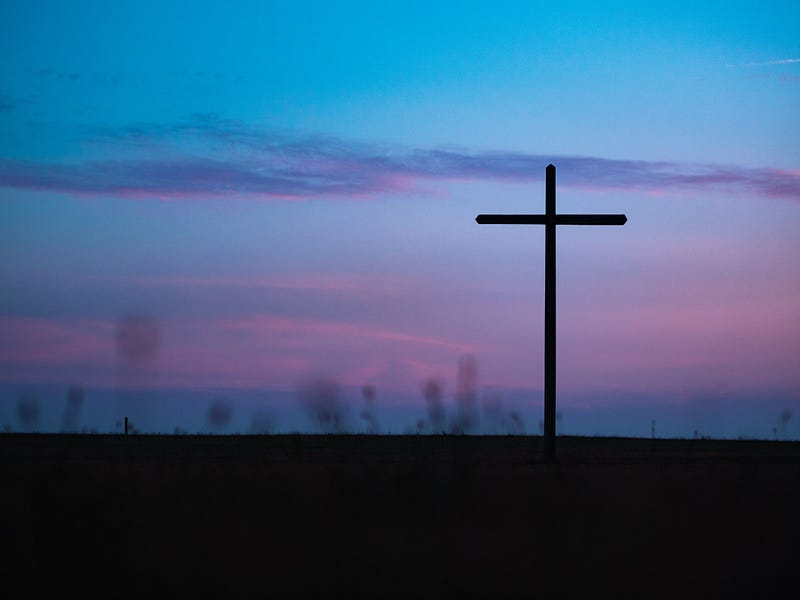
Objective in life: Following rules/morals, being a good citizen, a good Christian
Seeks truth in: A higher authority, be it the Bible, Constitution, or a political leader
| Characteristics |
|---|
| Collectivistic Strong belief system, often religious Strict morals & rules Hierarchical Closed-minded & dogmatic Nationalistic (our people, our religion, our race, etc.) Right-wing Pre-rational (belief-based, as opposed to fact-based) |
| Values |
|---|
| Rules Morality Ideology Hierarchies & social order Being proper |
| Examples |
|---|
| Ben Shapiro Organized religion Law & order The idea of punishments & rewards Middle school age Strict parents |

Lessons learned
- Importance of being responsible, following rules
- Importance of trust
- Importance of dedication and loyalty
Why evolve?
Stage Blue is too closed-minded and rigid; it doesn’t allow for more than one belief system, and that becomes an issue in a rapidly globalizing world. Stage Blue is also under a lot of guilt and pressure from trying to follow rigid rules, and repressing desires instead of transcending them.
Stage Orange — The Science & Success Stage
Stage Orange is all about “winning the game”, succeeding within the rules of society, and becoming the best, richest, smartest, most famous, best looking, etc.
At Stage Orange, you want to use science to manipulate reality to your own benefit.
Western society is at this stage, and likely you are too as a result.
Stage Orange comes with a bunch of technological benefits, smartphones, computers, software, and scientific discoveries, but lacks focus on emotions, human connection, and sustainability.

Objective in life: Winning the game of society, seeking understanding through facts & science
Seeks truth in: scientific facts, statistics
| Characteristics |
|---|
| Individualistic Competitive Focuses on success and improvement Pragmatic Scientific & fact-based Rational Highly materialistic Hedonistic |
| Values |
|---|
| Success, achievement, & excellence Looks Fame Materialistic things (money, sex, luxury) IQ Status Competition Facts & Science Technology Results, efficiency & pragmatism |
| Examples |
|---|
| Western society Businessmen & Entrepreneurs Supermodels Stephen Hawking Elon Musk Atheists Sports cars, mansions, luxury clothes Hollywood Advertisements Partying Hookup culture Bodybuilding & Steroids Scientism (science as a religion) |

Lessons learned
- The usability of technology & science
- The reliability & use of scientific fact
- The value of competition and trying to become better (self-improvement)
Why evolve?
Stage Orange is neither sustainable collectively nor individually. As a society, Stage Orange leads to issues such as pollution, climate change, and wealth disparity, whereas individually, it leads to depression, social isolation, and obesity.
Stage Orange is too individualistic and focuses too little on emotions and human connections, which are necessary for us as humans. Ultimately, Stage Orange doesn’t lead to happiness because of this; endlessly chasing things will never lead to happiness.
As it turns out, science and rationality aren’t all there is to reality either; there are fields of experience that cannot be measured, and so, left out by science. These fields and alternative belief systems, such as spirituality, could hold incredible potential benefits.
Rationality can’t solve all issues.
Stage Green — The Social Cause, Emotional, and Spiritual Stage
Stage Green is all about solving the issues of Stage Blue and Orange (climate change, inequality, sexism, racism), as well as about living a healthier and more natural life.
At Stage Green, self-improvement becomes less about looks and money, and more about healing trauma, connecting with your emotions, and exploring yourself.

Objective in life: Solve societal issues, build deeper connections, explore yourself, and heal emotionally and spiritually
Seeks truth in: emotions
| Characteristics |
|---|
| Collectivistic Empathetic Emotional Idealistic Believes that everyone is equal (people & animals) Other cultures are valid Feelings above rationality Anti-materialist, anti-consumerist, anti-greed Self-improvement oriented (emotion, health & spirituality focused) |
| Values |
|---|
| Health Equality Spirituality & meaning Deep connections Intimacy Emotional vulnerability Kindness & compassion Animal- & human-rights Finding middle-grounds Nature & environmentalism |
| Examples |
|---|
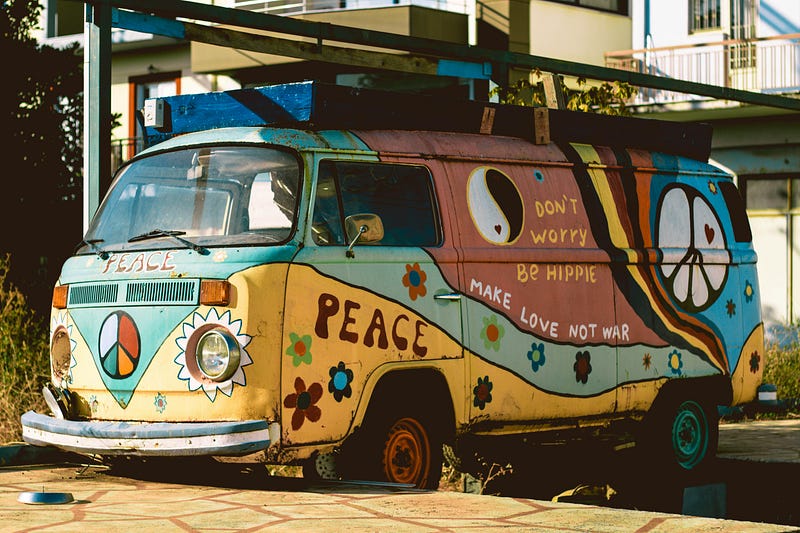
| Social justice warriors Vegans & vegetarians Hippies Activists Vox & Vice Psychedelics (for growth, not partying) Organic foods Tarot cards & crystals Health food stores Western yoga Protecting minorities Feminism Political correctness & gender pronouns University culture |
Lessons learned
- The importance of deep connections, emotions, and community
- The importance of healthy living
- The value of nature and spirituality
Why evolve?
Stage Green is too idealistic and doesn’t offer realistic solutions to complex systemic issues.
Stage Green is too sensitive and easily offended, the world is harsh, and sometimes you need the brutal truth (an issue for example with fat activism, and the glorifying of addiction & mental illness).
Stage Green easily leads to extremism, for example with Peta, Greenpeace, and Antifa.
There is almost always more than one truth, and issues are more complex. Stage Green is ultimately unable to take into account the other stages’ beliefs and needs, and is thus unable to solve complex social issues.
Stage Yellow—The Systemic Stage
Stage Yellow is the first stage on tier II; the first stage that understands the previous stages and their points of view.
At Stage Yellow there’s no longer just one truth, everything is more nuanced and multi-perspectival. Two conflicting things can be true at the same time, paradoxal and out-of-the-box solutions are the norm.
At Stage Yellow, solutions are more complex, and based on an understanding of the systems at play.
The difference between Stage Yellow and Orange is that Stage Yellow now understands the lower stages; it doesn’t demonize them. Stage Orange often demonizes Stage Green and Blue, whether it be the beliefs of Blue or the emotions of Green. Stage Yellow is in touch with its emotions, and is often more humble than Orange; Orange would most likely rate itself as Yellow to appear better, whereas someone at Yellow would be more nuanced and humble.

Objective in life: To live fully, to find one’s purpose, and live a balanced life with meaning
Seeks truth in: multiple perspectives (truth is relative)
| Characteristics |
|---|
| Individualistic Systemic (uses systems thinking) Aware of its own perspective and biases Contemplative Open-minded Relativistic & multi-perspectival |
| Values |
|---|
| Complexity & systems thinking Multi-perspectiveness, different points of view Self-improvement The big picture Creativity Ecology & sustainability Knowledge, learning, and understanding |
| Examples |
|---|
| Abraham Maslow Joseph Campbell Clair Graves Spiral Dynamics Top intellectuals & philosophers Joe Rogan Wikipedia Lifelong learning Meditation & contemplation Chaos theory |

Lessons learned
- The importance of multiple perspectives (as well as the danger of bias & delusion)
- The value of deep thinking, contemplation, and meditation
- Systems thinking
Why evolve?
Stage Yellow is too individualistic and “lone-wolf”; unable to solve complex global issues alone, needs cooperation & community.
Mind & models aren’t everything, there’s more to reality beyond “mind-stuff”. This requires more spirituality and deep philosophy.
Stage Turquoise — The Holistic & Global Stage
At Stage Turquoise, you recognize the importance of cooperation in solving complex issues. Stage Turquoise is no longer rooted in thinking and facts like Stage Yellow and is instead rooted in wisdom, insight, and being.
Many at Stage Turquoise have reached spiritual enlightenment because going beyond the mind is often necessary to reach this stage. Transcending the self is often necessary; individual survival isn’t the focus anymore.
The difference between Stage Green and Turquoise is that Turquoise doesn’t demonize the lower stages, it understands them. Stage Green gets easily triggered by injustice, whereas Turquoise understands where it’s coming from. Stage Green also holds tons of beliefs, about morality, crystals, and spirituality, whereas Turquoise is more rooted in experience. Lastly, the spirituality of Stage Turquoise is more serious and deep than at Stage Green, focusing on the meaning of life instead of spirits and trauma healing.
Objective in life: To lift up the well-being and consciousness of the world, to experience the wholeness of existence through mind and spirit (to embody, to be)
Seeks truth in: direct experience, in being
| Characteristics |
|---|
| Collectivistic Wise & insightful Emotional mastery (has a deep mastery of their emotions) Mystical (transcended the self, survives not for itself, but for the world) Heightened awareness & senses |
| Values |
|---|
| Mysticism, spirituality, nonduality Consciousness, awareness & love Truth, insight Humility Minimalism Compassion Being/experiencing instead of thinking, knowing, doing or having Human wellness Healing on all levels, physically, emotionally and spiritually Meditation, toga, and contemplation |
| Examples |
|---|
| Guru’s and sages (some at Blue) Yoda Mystics Prophets Eckhart Tolle Mooji Sadhguru Shinzen Young Master Oogway Nonduality |

Lessons learned
- The importance of global cooperation and community
- The importance of deep spirituality, understanding, and wisdom
- The importance of love and consciousness
Why evolve?
Stage Turquoise might seem like the final stage, but there is always more room for growth.
Stage Turquoise is often too mystical and spiritual, caring too little about earthly problems. Going into a cave to meditate and dying there isn’t the final stage.
Stage Turquoise can develop a guru complex and become seduced by power; remember that Turquoise isn’t perfect, it’s still human.
Stage Coral—The Being Stage
Stage Coral isn’t very relevant to cover because so few have ever reached this stage and it’s mostly just speculation.
Based on the issues with Stage Turquoise, Stage Coral might be more grounded in earthly reality, yet also more aware and conscious. Most understanding would come from becoming directly aware of how things are through insight and being.
Summary
Once you’ve come this far, I want you to go through your life and see if you can see the stages in your own life, in your development.
That was it for the stages. In the near future, I will also make posts about:
- The stages in more detail
- Dealing with the stages
- Tangents with other models (developmental stages, stages of thinking, Maslow’s hierarchy of needs)
- How to apply the model spiral dynamics to your life
If you liked the summary, give this post a like so I know. 🙂
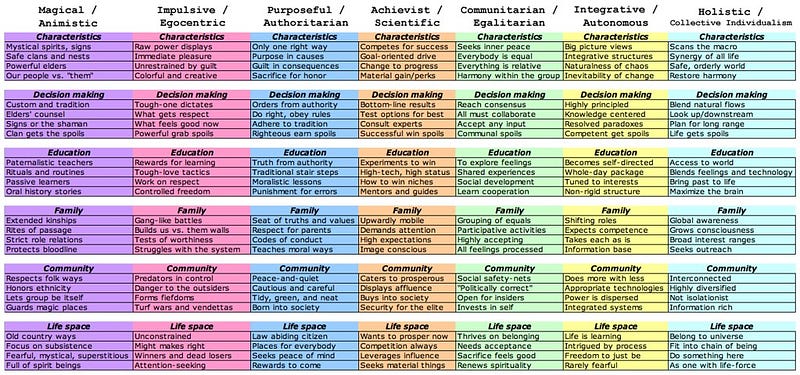
Anyway, here’s a nice picture to summarize the stages
 maxsaris.com
Leave a comment