
Disclaimer
I do not claim to have produced all of the following information myself. As for most of it, I have simply taken notes based on the content/courses, etc. that I have watched. Full credits go to the creators of said videos & courses.
I do not agree with 100% of the information in the notes, and they are to be taken with a grain of salt as for the validity. Most of the information below is useful and/or interesting to me, and I hope it will be of use to you as well.
Legal disclaimer: if you follow the advice/information in these notes, you are personally liable for the results.
Table of Contents
- Maslow’s Hierarchy Of Needs
- The one rule for acing life
- Balancing theory vs practice
- Self-actualization
- Awareness alone is curative
- The root cause of every addiction
- The upper limit problem
- Lifestyle minimalism
- How to deal with lack of results
- Paradoxes of personal development
- The role of balance in personal development
- Society appeals to the lower self
- 7 pillars of strategic thinking
- How to get results
- How to stop being a victim
- Responsibility vs blame
- Understanding resistance
- 40+ self-actualization techniques
- The self-actualized life
- Becoming a sage
- Advice for young people
- 10 things you don’t know you want
Maslow’s Hierarchy Of Needs
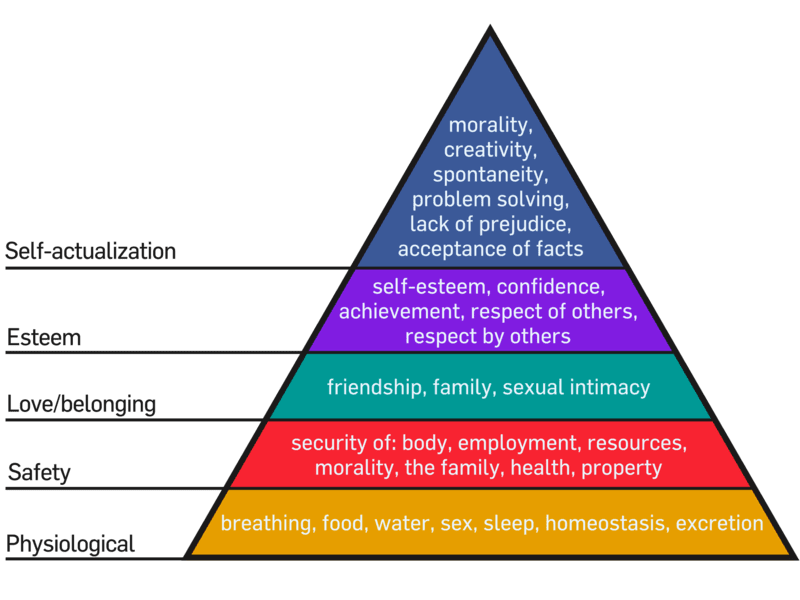 |
- The sixth level is about truth, spirit, consciousness, being, unconditional love, and enlightenment
- Fill out the holes on the lower levels in your 20s-30s and then focus on self-transcendence after that
- This will lead to the most fulfilling life possible
In life, we should strive to get higher up the levels
- Most people are stuck on the lower levels
- Fill out the holes on the lower levels in your 20s-30s and then focus on self-transcendence after that
- This will lead to the most fulfilling life possible
- Fill out the holes on the lower levels in your 20s-30s and then focus on self-transcendence after that
- You don’t strictly have to make it through the lower levels to get to the higher ones
- For example: yogis living in caves pursue self-transcendence
- The ultimate goal is raising one’s awareness until one becomes enlightened
- Because people are low on the hierarch of needs, raising their awareness is out of the question
- The biggest missing puzzle piece for most people is life purpose
| Questions to find out your next step 1. Where am I stuck on the hierarchy of needs? 2. What must I do to get unstuck once and for all? If the problem is lack of money, you have two solutions 1. Get more money 2. Get rid of your need to have more money |
The one rule for acing life
- Always do the thing that is emotionally the most difficult for you in any situation you find yourself in
- This is the exact opposite of what most people do
- Most people look for the most emotionally comfortable and easy things in life
- Applies to relationships, business, mood, finances, and the goals you pursue
- This is the exact opposite of what most people do
Living a good life is counter-intuitive
- Your mind is rigged to unconsciously pursue comfort
- You can’t live a good life if your prime directive is to seek emotional security and comfort
- Language, advertisement, books, political and educational system, religions, Society, education, politics, culture, and business is all rigged to cater to your ego seeking security and comfort
- The self-actualized life is emotionally challenging
- If you’re not happy with your life you have to bite the bullet and stop looking for magic solutions
Balancing theory vs practice
- Most people are too practical or theoretical
| Problems with being too pragmatic (practical) | Problems with theorizing |
|---|---|
| Very materialistic Selfish Chasing after gross experiences Not having a big picture understanding of life Not able to tap into spirituality | Armchair philosophy Mental masturbation Arguing and debating Not recognizing that the map is not the territory Over specialization (lacks big picture thinking) Not able to tap into spirituality |
Abilities within theory vs practice
- Theorizing without needing it to have any immediate value or pragmatic application
- For example, putting money into research doesn’t give immediate returns, but when it does, it could have huge implications
- See the practical consequences of your theorizing
- Ability to become motivated by good theory
- The ability to drop theorizing on a dime and likewise for action
- Ability to theorize in one way but take action in a different way
- Ability to see when you’re stuck in theory or practice
- Ability to see the limitations of both theory and practice
- limitation of theory: you can easily get lost in concepts that are disconnected from reality
- limitation of action: stuck in the cycle of mechanically doing stuff, forgetting being, theory, philosophy, and spiritual truths
- The ability to move forward despite paradox, confusion, and indecision
Self-actualization
- To be actualized is to live the best life you can live
- Self-actualization is a need, not a luxury
- Lower-level needs make you feel comfortable and safe
- For instance success, relationships, emotions
- Lower-level needs make you feel comfortable and safe
What does being self-actualized entail
- Superior perception of reality
- Increased acceptance of self, others, and reality
- Comfortable being themselves
- Increased spontaneity
- More focus on the problems and solutions instead of emotional reactions
- Increased detachment
- Valuing solitude
- Increased sense of autonomy
- Resistance to social conditioning
- Good sense of what is real/unreal
- More often in the flow state
- Increased creativity
- Understanding of who oneself is
- Driven by intrinsic motivation
- More loving
- Comfortable with paradox, contradiction, and confusion
- Positive desires and impulses
- Live in the present moment
- More conscious decisions
Ideal values
- Truth
- Beauty
- Goodness
- Uniqueness
- Holiness
- Justice
- Simplicity
- Richness
- Effortlessness
- Playfulness
Awareness alone is curative
- Neurosis: the excessive use of will, force, and action to try to change one’s behaviour
- Leads to self-sabotage
- More action isn’t always the answer
- Awareness alone is curative
- Unhealthy behavior will autocorrect itself through the process of observation (awareness)
- It’s impossible to engage in unhealthy behavior while fully conscious
Method
- Requires constant awareness through the whole thing
- Requires patience
Mistakes people make
- Assuming that awareness is the same as logical knowing
- Assuming that being aware is the same as moralizing
- Assuming awareness is suppression
- You’re not suppressing anything, if you have a desire to do something, do it, but be aware while doing it
The root cause of every addiction
- If you stop the behavior you suspect you’re addicted to and cravings arise it means you are addicted
- Almost everyone in modern society is an addict
- Most people have dozens of addictions
Common addictions
- Drugs
- Food
- Porn
- Tobacco
- Alcohol
- Tv
- Internet
- Video games
- Socialization (partying and chit-chatting with friends)
- Shopping
- Work
- Gossip
- Thinking
The root cause of all addiction is the fear of emptiness
- You can recognize this fear of emptiness if you simply sit in a room and do nothing
- Almost nobody can stand simply sitting in a room doing nothing
- So we turn to “X” to distract ourselves
- Almost nobody can stand simply sitting in a room doing nothing
- The degree to which you can simply sit in an empty room without cravings, agitation, and being lost in thought is your level of self-development
- We stuff ourselves with our addiction until we are aching and feel guilty
- In the end, we cannot fill the emptiness of being with more doing or with material/external possessions or activities
- No matter how much you try you cannot do it
- Being is by nature empty
Conquering addiction
- You have to face the void at some point if you want to conquer addiction
- To conquer addiction you have to sit with emptiness and do nothing
The upper limit problem
- When we get too much of anything we get off of homeostasis
- This leads to us doing something to bring ourselves back
Common ways of upper limiting
- Getting sick/hurt
- Worry
- Criticism and blame
- Deflecting
- Squabbling (arguments)
- Integrity breach (lies, withheld truths, broken promises)
- The false foundation under the Upper Limit Problem is a set of four hidden barriers based on fear and false belief
- Feeling fundamentally flawed
- Disloyalty and abandonment
- Believing that more success brings a bigger burden
- The crime of outshining
Lifestyle minimalism
- The typical Western lifestyle leaves no free time
- The modern lifestyle is unhealthy and neurotic with depression, anxiety, and phobias running rampant
- One should aim to have a simple life with lots of free time to think
- One should slow down one’s own life by 25-50% and do everything 50% slower
- Wealth can be measured in terms of money or in terms of free time to think, contemplate, and be aware
- Success doesn’t help at all if you aren’t fulfilled
- One should aim to have a simple life with lots of free time to think
Key things to focus on in life
- Meditation
- Enlightenment
- Life purpose
- Learning/education
- Slow deliberate mindful action
- Contemplation
- Being
Things you should minimize
- Friendships
- Relationships
- Family commitments
- Hobby’s
- Any entertaining fun activities
- Your life should feel like summer vacation from school all the time
- This requires letting go of success and goals
- Requires saying No a lot
- Requires letting go of your carnal cravings (food, sex, music, fun, entertainment, stimulation)
- The alternative is sitting and doing nothing
- While it sounds shit, really it leads to the most amount of fulfillment
- The alternative is sitting and doing nothing
How to deal with lack of results
- We set unrealistic expectations
- We often psyche ourselves out even if we have a clear path and a goal just because of a lack of patience
- The mind expects too much too fast regarding large goals
- We often overestimate what we can do in a year but underestimate what we can do in five
- The mind sucks at distributing work evenly across time
- Results don’t come linearly, they come exponentially
- The beginning of every project is the longest and most emotionally difficult
- The level of patience you apply should be proportional to the size of the goal
How to apply the principle of patience
- Become conscious of and change your self-talk
- Become conscious of the long-term and the bigger picture of what you’re doing
- It’s easy to see if something really isn’t working for you
- Usually, if something is working you will still get small rewards
- These rewards tell you that you’re going to get exponential rewards down the line
Questions to determine between impatience and patience
- One area of my life where I’m trying to go too fast is?
- Why am I in such a rush?
- If I took twice as long would it still be worth it?
- If I embraced the principle of patience I would?
- How would my expectations change if I cared deeply about long-term results?
- What exactly does a lazy pace look like for this project?
- What exactly does an impatience pace look like here for this project?
- What exactly does a wise pace look like for this project?
Paradoxes of personal development
- Paradoxes are a necessity if you’re going to self-actualize and develop yourself
- Big picture understanding of life is important because it helps you build the kind of life you want
Paradoxes
- You are already complete yet you must do self-help and work really hard
- You have real problems that need to be fixed yet your problems are illusory and problem-solving is not the best way to live a good life
- Relationships can give you lots of fulfillment and are one of the highest quality of happiness you can have yet relationships can never truly make you happy
- You have to make yourself happy from the inside and you can’t rely on other people to make you happy
- Be wise and don’t make unwise decisions in your life so you are not making a lot of the mistakes other people make in society yet in history the greatest people’s lives are constructed around their biggest mistakes,
- failure is good
- The more we fail the stronger we become
- Think about and contemplate life, live a contemplative life, and plan ahead yet thinking creates neurosis and you should stop thinking
- Work hard to make yourself attractive to the opposite sex and get that great relationship yet you shouldn’t work at all to be the most attractive
- Be cool, be detached, be independent of outcome, don’t be needy, don’t even try to act attractive
- To get into a relationship, don’t need a relationship
- If you really need a relationship you probably won’t get one
- This is because nobody will want to be in a relationship with you
- If you are very independent and don’t need nor want a relationship then everyone will want to be in a relationship with you because you’re not needy
- Be present in the moment yet delayed gratification is good, don’t focus on the present or you will be hedonistic
- Be very careful with your mind and ego because it’s very deceptive yet you should trust yourself completely to be really fulfilled in life
- Never quit, yet prioritize and cut losses early so you are not going down a dead end
- Paradox of happiness, to be happy, don’t think about happiness, if you are thinking about happiness you are not really happy, yet if you are not thinking about happiness you will be just like the majority of people
- Be selfless, but to be selfless work on yourself really hard
- To be selfless be selfish
- To be the most authentic self, eliminate yourself and eliminate the ego, you are using your ego to eliminate your ego
- The paradox of spiritual enlightenment: on one hand you exist and on the other hand you don’t exist, literally
- Meta paradox: embrace paradox and be open to contradiction yet create a perfect worldview and jigsaw puzzle of reality
 maxsaris.com